
-
Work Cited Copp, David. “International justice and the basic needs principle.” In The Political Philosophy of Cosmopolitanism, edited by Gillian Brock and Harry Brighouse, 39-54. Cambridge: Cambridge University Press, 2005. “Justice requires a state in favourable circumstances to enable its members to meet their basic needs throughout a normal lifespan”: the “basic needs principle” (39).…
-

The book is like a diamond sparkling many facettes. I retain the opposition between patriotism and cosmopolitanism – an opposition also noticed by Martha Nussbaum in her article “Patriotism and Cosmopolitanism” published in the Boston Review, 1994. “I am willing,” he said, “to serve my country; but my worship I reserve for Right which is…
-

Benhabib, Seyla (2002), The Claims of Culture: Equality and Diversity in the Global Era, Princeton, NJ: Princeton University Press. Global integration is progressing parallel to social disintegration (separatisms, international terrorism, national revival). “Yet wether [sic] we call the current movements “struggles for recognition” (Charles Taylor, Nancy Fraser, and Axel Honneth), “identity/difference movements,” [sic] (Iris Young,…
-
Work Cited Rosenfeld, Sophia. “Citizens of Noweher in Particular: Cosmopolitanism, Writing and Political Engagement in Eighteenth-Century Europe.” National Identities 4, no. 1 (2002): 25-43. Contention of the essay: the development of the conceptual space of political engagement among private subjects cannot be reduced to the creation of national loyalties. A body of literature existed, produced…
-

Mortier, R. (2000). Le rêve universaliste de l’”Orateur du Genre humain”. In R. Mortier, Les Combats des Lumières (pp. 385-394). Paris: Aux amateurs de livres international. The Universalist idea was not something new or invented in the eighteenth century. However, the transformation of the feeling of being human into concrete political and social systems is…
-
Work Cited Fink, Gonthier Louis (1997) “Cosmopolitisme.” In Dictionnaire européen des lumières, edited by Michel Delon, 277-279. Paris: Presses Universitaires de France. « Le XVIIIe siècle est le siècle du cosmopolitisme » (L. Réau). (277) « En 1690, le Dictionnaire universel de Furetière, qui ne connaît pas encore le terme « cosmopolite », le définit indirectement à l’article…
-

Introduction: cosmopolitanism, narrative, history Cosmopolitan history: “‘Cosmopolitanism’ is no longer a term much favoured by intellectual historians: as an idea, it seems to lack intellectual content; as a category of political thought, it has no referent. [footnote: “the last investigation of this idea was Thomas J. Schlereth]. The term is occasionally invoked by literary and…
-

Historiographie du mot “cosmopolite.” Hazard, Pierre (1930) “Cosmopolite.” In Mélanges d’histoire littéraire générale et comparée offerts à Fernand Baldensperger, 354-364. Paris: Libraire ancienne Honoré Champion. Résumé: Apparition au XVIe siècle : 1560 Guillaume Postel De la République des Turcs et, là où l’occasion s’offrera, des mœurs et des lois de tous muhamedistes, par Guillaume Postel, cosmopolite.…
-
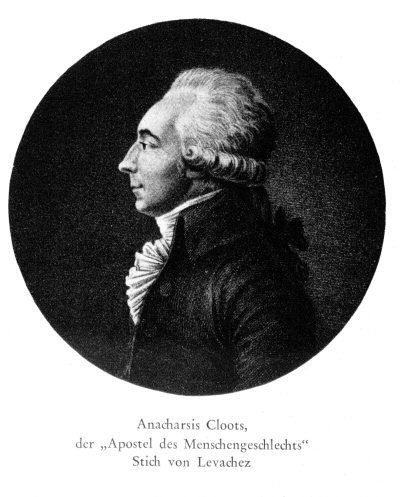
Avenel, Georges (1865), Anacharsis Cloots: L’orateur du genre humain, Paris : Librairie internationale. This is one of the very first biography existing on this not so well-known history character of the French Revolution, Anacharsis Cloots. The merit of this book is its weakness: the tone in which it is written. The author is writing in a…
-

Bélissa analyses the conquests made by the new French Republic in Italy (an IV-V), Switzerland (an VI-VII), Holland (an III), and Belgium (an III-IV). These countries are called “sister-Republics.” Patriots in these “sister-Republics” are European militants and support the French Republic, at first, in its fight against monarchical Europe (91). These patriots have conscious to…
 Frank Ejby Poulsen